


If you’re replacing or installing a flat roof, you’ve probably noticed there isn’t just one obvious choice. GRP fibreglass, EPDM rubber, and liquid overlay systems all claim to be the best flat roof material for durability, cost, and ease of installation — and the truth is, the right answer depends on your specific project. In this guide, we’ll break down how each one performs, what it costs, and which jobs it suits best, so you can make a confident decision before you order a kit.
Why Flat Roof Material Choice Matters
A flat roof doesn’t have the luxury of gravity doing most of the work the way a pitched roof does. Water needs to be actively shed or sealed against, which means the covering material has to handle standing water, UV exposure, and thermal movement without cracking, blistering, or lifting at the seams. Choosing the wrong material — or installing the right one poorly — is one of the most common reasons flat roofs fail within just a few years rather than lasting their full 20–50 year lifespan.
That’s why so many self-builders and tradespeople researching flat roofing end up comparing the same three options: GRP, EPDM, and liquid roofing systems.
GRP Fibreglass Roofing
GRP (Glass Reinforced Plastic) is a rigid, seamless roofing system built up from fibreglass matting saturated in resin, finished with a protective topcoat.
Pros:
Fully seamless — no joints for water to find
Extremely durable once cured, with a lifespan of 25+ years
Walkable surface, which suits roofs used as balconies or roof terraces
Good for roofs with complex shapes, upstands, or dormers
Cons:
More technical to apply than rubber — requires correct resin-to-catalyst ratios and good weather conditions
Rigid, so less forgiving of structural movement than EPDM
Strong odour during application
Best suited to: garages, extensions, dormers, and roofs with awkward detailing where a rigid, moulded finish works in your favour.
Our GRP fibreglass kits are supplied with everything needed for a complete system, sized to your exact roof dimensions.
EPDM Rubber Roofing
EPDM is a synthetic rubber membrane, typically supplied as a single sheet that’s rolled out, bonded down, and dressed into the roof edges using trims.
Pros:
Extremely flexible — handles thermal movement and structural flex without cracking
Genuinely single-piece seamless coverage on most domestic roof sizes
Fast to install compared to GRP — a competent DIYer can often complete a standard shed or garage roof in a day
30–50 year lifespan when installed correctly
Cons:
Needs careful handling during installation to avoid creasing or trapping air
Detailing around complex upstands can be more fiddly than with a moulded GRP finish
Best suited to: sheds, garages, extensions, and dormers — particularly where DIY installation is the goal, since it’s widely considered the most forgiving system for a first-time installer.
Browse our EPDM rubber roofing kits and trims to put together a complete kit for your roof size.
Liquid Roofing Systems
Liquid roofing (sometimes called liquid overlay or liquid-applied waterproofing) is a resin or polymer-based coating applied by roller or brush, curing into a seamless, flexible membrane.
Pros:
Ideal for refurbishing an existing roof without stripping it back to the deck
Handles complex details, pipes, and upstands easily since it’s applied wet
No seams or joints at all
Can often be applied in a single day, including drying time for thinner coats
Cons:
Surface preparation is critical — any contamination or moisture in the existing substrate will compromise adhesion
Typically a shorter lifespan than EPDM or GRP (though still commonly 15–25 years depending on the system)
Weather-dependent application window, similar to GRP
Best suited to: refurbishing an ageing felt or asphalt roof, repairing localised damage, or roofs with complicated detailing that would be difficult to dress with a sheet membrane.
So, Which Is the Best Flat Roof Material for Your Project?
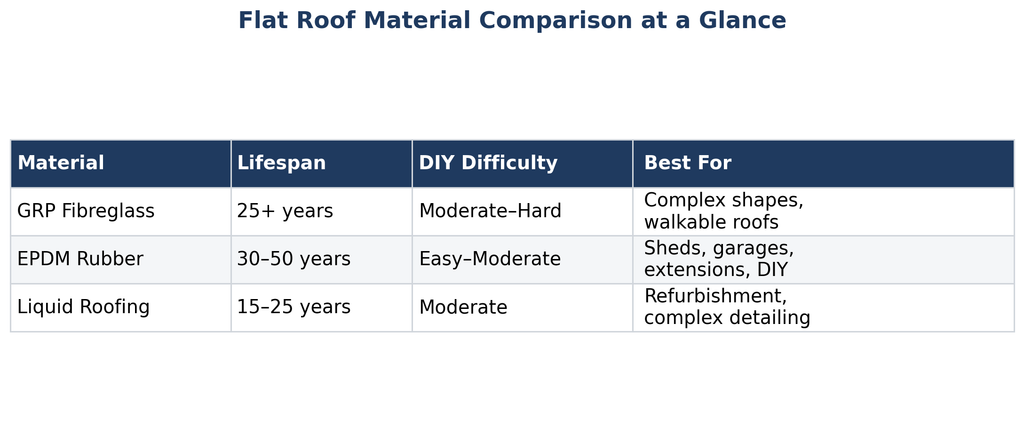
If you’re after the longest lifespan with the easiest DIY installation, EPDM rubber is generally the strongest all-round choice for garages, sheds, and extensions. If your roof has complex detailing or will be walked on regularly, GRP’s rigid, moulded finish is worth the extra installation effort. And if you’re refurbishing an existing roof rather than starting from the deck up, a liquid system is often the most practical and cost-effective route.
Whichever material suits your project, getting the quantities right matters just as much as the material itself — an undersized kit or missing trims is one of the most common (and avoidable) causes of a frustrating install. If you’re not sure what you need, our team is happy to help you work out the right kit for your exact roof dimensions before you order.
Frequently Asked Questions
How long does a flat roof covering last?
Depending on the material and installation quality, a flat roof covering typically lasts 15–50 years — EPDM rubber generally offers the longest manufacturer-backed lifespan.
Can I install a flat roof myself?
Yes — EPDM rubber kits in particular are widely installed by competent DIYers, provided the roof deck is sound and you follow the manufacturer’s bonding and trim instructions closely.
What’s cheaper, GRP or EPDM?
Material costs are broadly comparable for most domestic roof sizes, though GRP often costs more in labour if you’re hiring a professional, since application is more technical.